Attribution helps you determine how much credit each campaign interaction deserves for achieving a specific goal on your website. To make this possible, our system uses the concept of Customer Journeys, which are sequences of campaign interactions leading up to a defined Website Goal.
1 Website Goals
Website goals are specific actions that indicate meaningful user engagement or conversion (e.g., placing an order or subscribing to a newsletter). These goals are the foundation for creating Customer Journeys and enabling attribution calculations. Without website goals, there are no Customer Journeys, and therefore no attribution is possible.
Why are website goals important?
A website goal tells the system what constitutes a successful user action. Once a goal is defined, our tool tracks all campaign interactions that lead up to this goal, creating a Customer Journey.
Examples of website goals:
Order (activated by default)
Product added to the shopping cart
Custom Events (e.g., newsletter subscriptions, downloads)
For more information on setting up website goals, refer to our training chapter on Analysis of Goal Achievement.
2 Customer Journeys
A Customer Journey is a record of all tracked campaign interactions that occur before achieving a defined website goal. By capturing the sequence of user interactions, it provides the foundation for attribution.
Key Details about Customer Journeys:
Only successful campaigns—those that lead to a website goal—are saved.
A maximum of 15 campaign interactions are recorded. If more interactions occur, the first and last 14 are saved.
The default tracking period is 30 days before the goal but can be extended to 60 days per campaign configuration.
Why Customer Journeys Matter for Attribution:
Customer Journeys provide the data needed to assign credit for a goal to one or more campaigns. Attribution models then calculate how much credit each interaction deserves.
3 How Website Goals and Customer Journeys Work Together
The image illustrates how website goals define Customer Journeys and enable attribution:
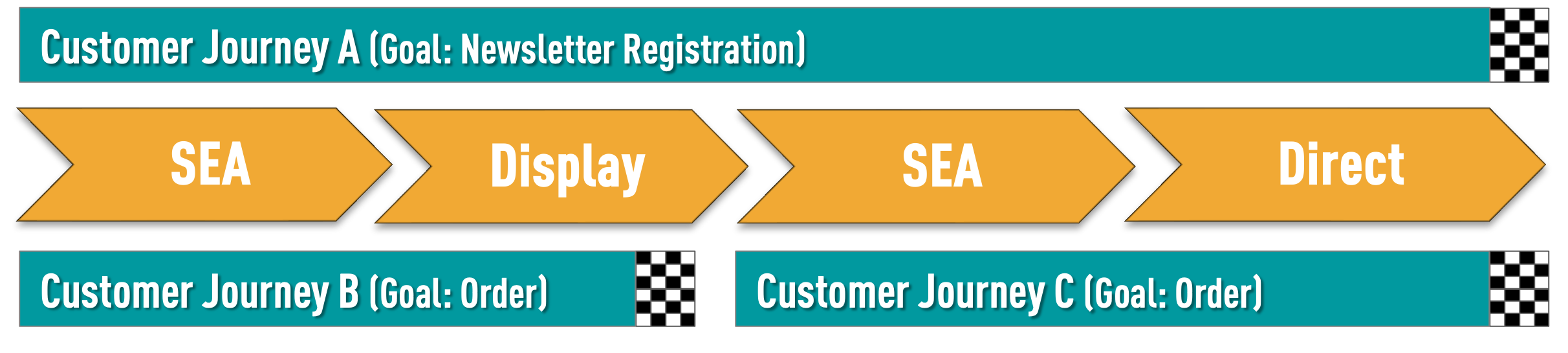
A user interacts with four campaigns in sequence
The user completes two website goals during their interaction:
First Order: Achieved after the SEA Campaign.
Second Order: Achieved after the Direct Campaign.
Newsletter Registration: Completed after the Direct Campaign.
Each time a website goal was reached, this resulted in creating a three distinct Customer Journey.
This example demonstrates how website goals trigger the creation of Customer Journeys. Each journey captures campaign interactions leading up to a specific goal, allowing attribution models to analyze and assign credit appropriately.
4 Overview of Attribution
Attribution models dictate how credit for website goals is distributed among campaigns within a Customer Journey. They allow you to analyze campaign performance and optimize your marketing strategies.
What is Attribution?
Attribution determines which campaign interactions within the Customer Journey receive credit for a website goal.
Types of Attribution Models:
Single Assignment Models: Assign credit to one campaign per goal, focusing on a specific interaction.
Multiple Assignment Models: Distribute credit across multiple campaigns, providing a more comprehensive view of the Customer Journey.
Explore the detailed explanation and examples of each attribution model to decide which best suits your goals: